The Game UX Pyramid: Six Levels of Player Experience
First published as an Acagamic Tip Tuesday on acagamic.com. Edited for this archive.
This issue breaks game UX down level by level. Player experience is the product of the mechanics and systems that designers, developers, and UX teams build.
UX design in games
UX design draws on human psychology to understand and meet user needs. In games, UX means making a game that is easy to understand, fun to play, and memorable. Players stay engaged when they want to spend time with the game’s features, from levelling up to the end game.
The pyramid
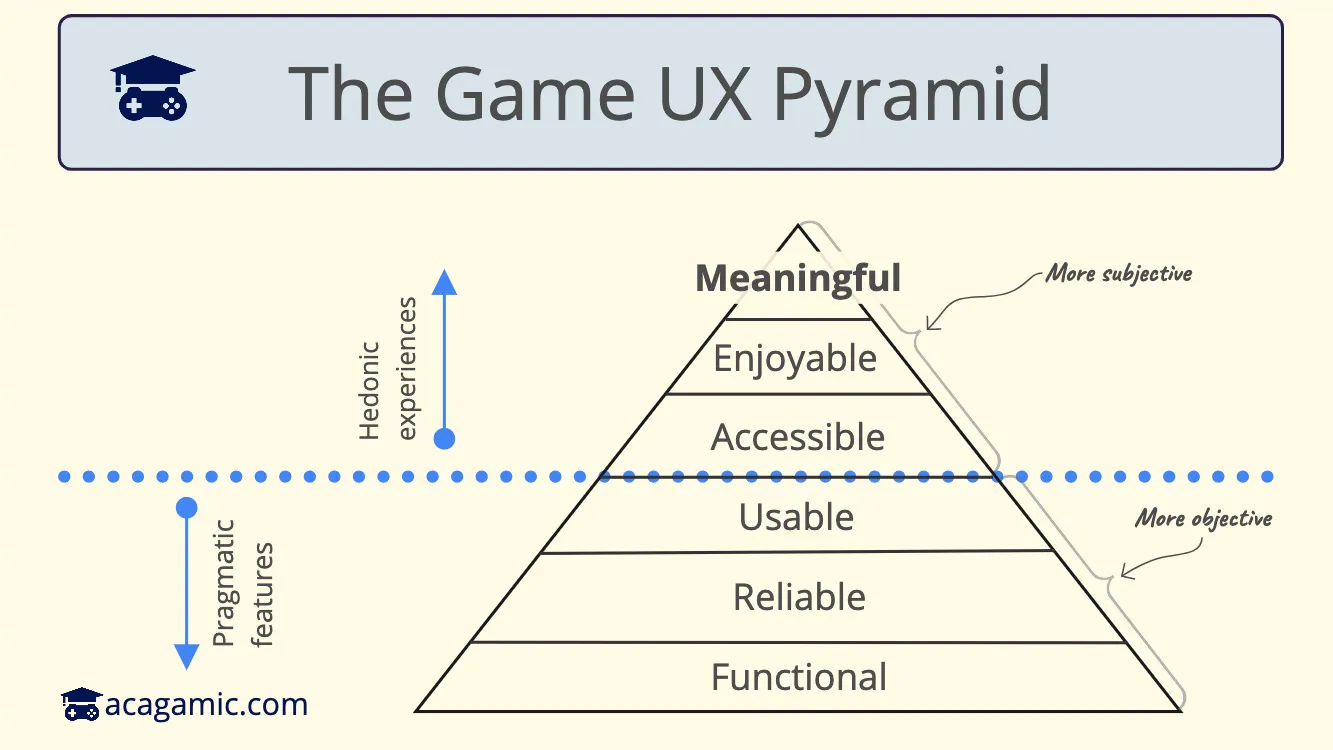
The pyramid builds on Avi Vijh’s adaptation of the UX pyramid and on ideas from Stephen Anderson’s book Seductive Interaction Design. It orders player needs from the most basic at the bottom to the most complex at the top. Teams build from the bottom up, and each level depends on the ones below it. I wanted to apply the idea to user research and interfaces in games.
Too many teams get stuck in the trenches of development. They juggle fragmented player feedback, level design, playtests, complex mechanics, and menu animations, and they lose sight of what makes a game memorable: an experience built around the player. That doesn’t mean making the game easy. It means players can enjoy it. Here is how the levels unfold.
Level 1: functional
The game does what it is supposed to do. It runs smoothly on its target platforms, includes the core features, and meets basic accessibility standards. Test different resolutions and frame rates, for example, to confirm that UI elements scale.
Prioritize the actions players take most and cut unnecessary clicks. Keep onboarding short and reduce repeated inputs. Save progress, so players can quit and return without losing anything. Keep the learning curve gentle with clear actions, marked tasks and quests, progress bars for multi-step tasks, and advanced features turned off by default.
Level 2: reliable
Nothing should be ambiguous. Feedback must be accurate and clean on every console, phone, and device you target. Know the devices your players use, and build interfaces that work correctly on each one.
Level 3: usable
A game should be a map players want to explore, not a maze where they get lost. Controls should be easy to understand. Feedback should be clear and consistent. Players should find what they need without effort, unless finding things is the challenge. This level covers the basics of game UX practice.
Work with UX experts and test with players. Watch people play, collect data on their performance, and refine the design based on what you see. Learn to run heuristic evaluations, playtest often, and use analytics to find and fix usability problems.
Level 4: accessible
At this level, the game reaches out to the player rather than waiting for them. Remove physical and cognitive barriers to play. Give clear instructions and tutorials, so every feature is easy to understand. Put information exactly where players need it. Set clear expectations, and let players control their own experience and challenge level.
Level 5: enjoyable
Players enjoy the game when they come back to it and recommend it to friends. Random elements keep players on their toes with surprise and anticipation. Level editors let players shape the game to their preferences and set their own challenges. Co-operative and social features make play more engaging. Helping players recover from mistakes also improves the experience.
Level 6: meaningful
Here the game becomes more than a pastime, and players reflect on what they did. Some games ask players to weigh the ethical consequences of their choices. Others reward meaningful decisions rather than completed tasks. Others steadily raise the difficulty to reward growing skill and strategy, and gripping stories reward players with surprising turns.
To reach the top, remove pain points and unintended obstacles. Help players grow their skills, and even their health and well-being. Think about the experience beyond the game’s content, and keep up with players’ changing needs through regular player research.
Use the pyramid as a compass for your next player-centred project. It explains why some games soar while others sink. Use player research to find the levels that need work, prioritize them, and keep the game’s UX evolving with its players.
Enjoy Reading This Article?
Here are some more articles you might like to read next:
- Your Replacement Would Cost $500K
- The 7 psychology principles game designers learn too late
- You’ve normalized something insane about peer review
- How to pick a research problem that actually matters
- Be aware of readers like Warren Buffett. They know something you forgot in sixth grade.
- The AI Responsibility Framework for UX Researchers
- Your Proposal Didn’t Fail. Your Writing Did.
- As a Professor, I Refuse to Store My AI Research in the Cloud
- Your Deep Expertise Is Why Nobody Knows Your Name
- Prompt Engineering Is Your Most Expensive Habit