How to Use Observation in Games User Research
First published as The Acagamic Tip Tuesday #3 on acagamic.com. Edited for this archive.
Use observation systematically to study your users in the field.
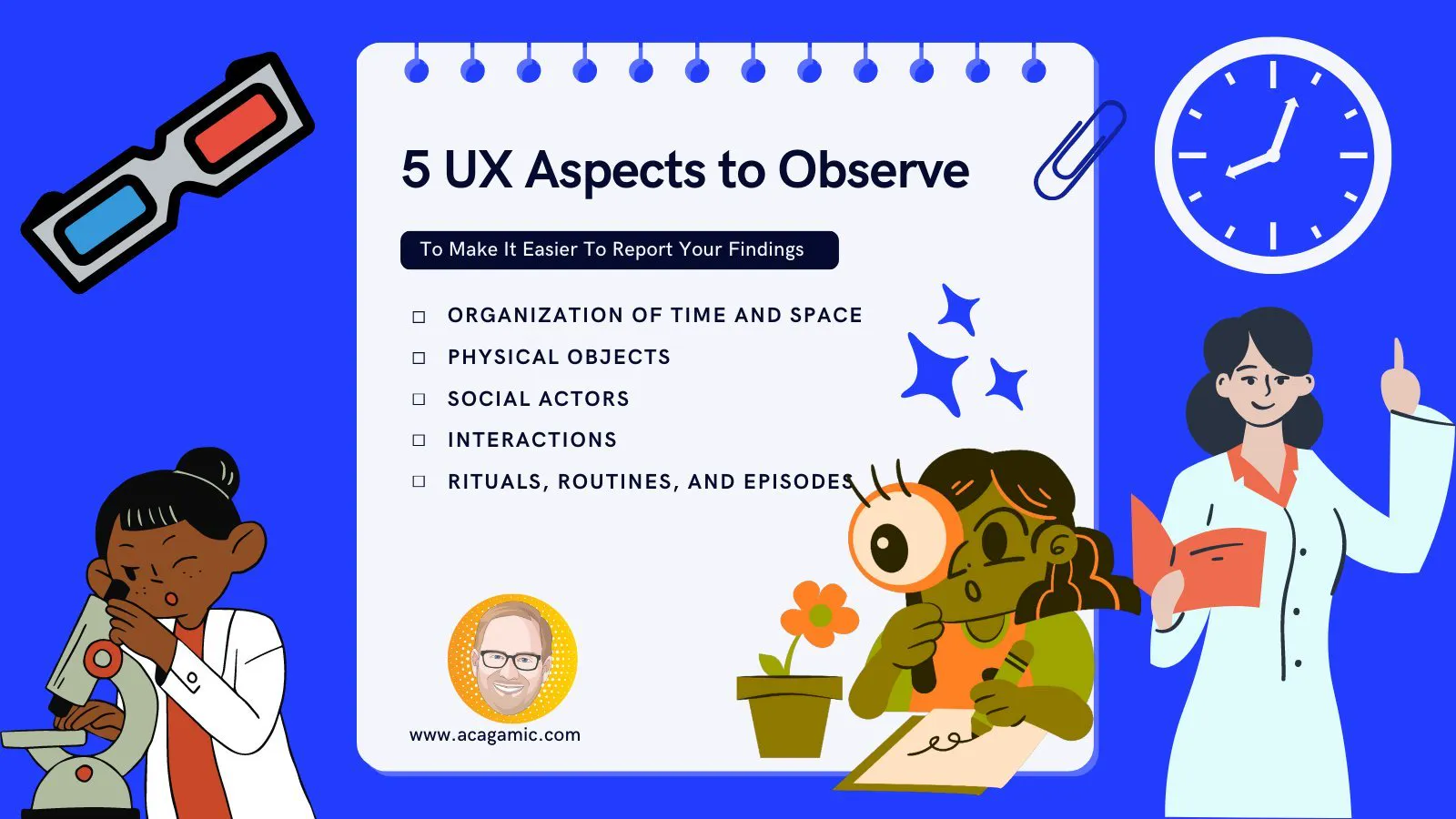
Curiosity drives most observation, but good UX research needs a system and a purpose. If you know what to watch for, writing up your findings later gets much easier. Here are five aspects to observe.
Organization of time and space
In a field study, channel your inner anthropologist. Watch how people organize their time, who makes decisions, and which activities and events take place. This gives you a feel for how the action flows.
Pay close attention to the layout and furnishing of the space, because groups and individuals mark and protect their territory. Does that lead to conflicts you can see?
Physical objects
Objects carry meaning. Note which objects are present and how people use them. What does each one symbolize here? Which are private, and which are shared? Does anyone control access to them?
Social actors
How people look and behave in a shared space tells you about its social structure. Can you read status and social roles from people’s relationships? Is there a visible professional hierarchy, or does everyone seem equal?
Interactions
Watch what people do and how they do it. Notice nonverbal behaviour, and listen to what people say formally and informally, including tone, topics, and context. Find out who communicates with whom, when, and where. Then reflect on your own feelings and reactions. Why are you responding the way you do?
Rituals, routines, and episodes
Separate routine actions from unusual ones. Which rituals are formally recognized, and which happen informally? Look for episodes: chains of action and reaction between people. How do people express their emotions?
Accept that you are human
You cannot observe everything. Narrow your focus to your research problem.
This tip draws on Ciesielska, M., Boström, K. W., and Öhlander, M. (2018). Observation methods. In Qualitative Methodologies in Organization Studies (pp. 33–52). Palgrave Macmillan.
Enjoy Reading This Article?
Here are some more articles you might like to read next:
- Your Replacement Would Cost $500K
- The 7 psychology principles game designers learn too late
- You’ve normalized something insane about peer review
- How to pick a research problem that actually matters
- Be aware of readers like Warren Buffett. They know something you forgot in sixth grade.
- The AI Responsibility Framework for UX Researchers
- Your Proposal Didn’t Fail. Your Writing Did.
- As a Professor, I Refuse to Store My AI Research in the Cloud
- Your Deep Expertise Is Why Nobody Knows Your Name
- Prompt Engineering Is Your Most Expensive Habit